Game review
GTA VI Is the Greatest World Ever Built. But Is It the Greatest Game Ever Made?
Rockstar has pulled off the greatest presentation in video game history. The irony is that its commitment to realism exposes the limits of its own game design.
I study how your customers think, and fix what's keeping their interest from turning into revenue.
My 70-year-old mother knows what Grand Theft Auto VI is.
She doesn't play video games. She doesn't follow Rockstar Games. She couldn't tell you the difference between a PlayStation 5 and an Xbox Series X. But she knows GTA VI came out, and she knows everybody is playing it.
Before we even talk about the game itself, I want you to appreciate how ridiculous of an achievement that is.
Rockstar has become the Michael Jordan of video gaming. Its legacy, cultural relevance, marketing and reputation have outgrown the medium itself. Its competitors release video games. Rockstar creates cultural events.
After spending a lot of time in Leonida, I can confidently say Rockstar has delivered the single greatest presentation in the history of video games. I can also confidently say GTA VI is not a perfect 10.
And the reasons why are a lot more interesting than the score itself.
When Reality Starts Looking Like a Video Game
I live in Florida. One of the strangest experiences I've had since playing GTA VI is going outside and feeling like I'm still playing it.
The vegetation. The architecture. The cars. The lighting. The roads. The peculiar assortment of human beings you run into on any given afternoon in Florida. Rockstar recreated my surroundings so convincingly that reality and simulation have flipped. Real life reminds me of a video game.
Think about that.
The graphics are second to none. The voice acting is incredible. The motion capture is so convincing that watching two characters have an ordinary conversation can be as entertaining as playing a mission. The banter between Jason and Lucia, and everyone they run into, flows so naturally you forget it was written.
The cars don't just look like their real-world counterparts. They feel like them. They have personality, weight and their own handling.
The pedestrians have different body types, mannerisms, clothes, personalities and behaviors. Their conversations rarely repeat. Watching NPCs interact with each other is entertainment in itself.
Maybe Rockstar's most impressive accomplishment is its ability to create content within the content. There are video games inside the video game. TV shows. Stores. Businesses. Entire places that exist mostly to make the world feel like somewhere people actually live.
Most developers struggle to make their main content compelling. Rockstar is making fictional entertainment for fictional people inside its own entertainment product.
That's an absurd level of craftsmanship. But it also creates a fascinating problem.
The Burden of Being Too Good
At three in the morning, I decided to rob a jewelry store.
Naturally, I expected the lights off, the doors locked and some kind of overnight security. Instead, the clerk was standing there like it was two in the afternoon. Apparently the jewelry industry in Leonida runs on Waffle House hours.
In almost any other game, I wouldn't have cared. In GTA VI, it immediately broke my immersion, because Rockstar had spent countless hours convincing me its world runs on the same common sense as mine.
When gunfire breaks out, police dispatch responds. Officers talk over the radio. You know law enforcement is on the way, so there's a second threat even after you've taken out the first one. You can't stand around admiring your work. You've created a problem, and now you have to leave.
It's brilliant. The world reacts to your behavior in a way that makes sense.
Which is exactly why walking into a fully staffed jewelry store at 3 a.m. feels so strange. Rockstar raised the standard its own world has to be judged by. The closer a simulation gets to reality, the more you notice where it breaks from reality.
I wasn't disappointed because the game failed some unreasonable expectation I made up. I was disappointed because the game had already taught me to expect better.
The Most Beautiful Props in Video Game History
The interiors in GTA VI are unreal.
Walk into a building and look around. The furniture, appliances, decorations, clutter and individual objects are meticulously designed. These aren't generic rooms built from a handful of interchangeable assets. They look lived in.
The problem is that most of what you're looking at doesn't do anything.
When I infiltrate a criminal hideout, I'm usually looking for a handful of valuables: cash, jewelry, drugs or vehicles. So despite standing inside one of the most detailed indoor environments in video game history, I end up sniffing the walls and spamming Triangle.
I'm basically a Roomba with a criminal record.
The game has accidentally trained me to ignore the very craftsmanship that makes it special. I'm not looking at the room. I'm scanning for interaction prompts.
There's an important difference here between environmental detail and environmental depth. Detail is how convincingly something is represented. Depth is what you can actually do with it. An object can do a lot for visual immersion without doing anything for mechanical immersion.
I'm not saying every toaster in Vice City needs a working electrical system. But when a game reaches this level of fidelity, I naturally want to engage with more of what I'm seeing. I don't just want to admire the world. I want to participate in it.
And this is where another game enters the conversation.
Kingdom Come: Deliverance II Has Something Rockstar Doesn't
I genuinely believe Kingdom Come: Deliverance II belongs in the same conversation as GTA VI. In certain ways, I think it's better.
Not graphically. Not in cinematic presentation. Not in the sheer size of the production. Mechanically.
In Kingdom Come, the time of day matters. Your clothes matter. Your reputation matters. Your physical condition matters. Your preparation matters. The environment isn't just a backdrop for your adventure. It's a web of connected systems that shape your decisions.
I've spent a lot of time making money through alchemy, building skills, getting better gear and learning how the world works. Those activities aren't distractions from the main story. They fundamentally change what I can do in the game.
The satisfaction doesn't only come from watching Henry become more capable. It comes from me becoming a more capable player.
Rockstar makes me believe I'm looking at a real world. Warhorse makes me believe I'm participating in one. Both are huge achievements, but they're not the same thing.
If you could somehow combine Rockstar's presentation with Warhorse's systemic depth, I'm not convinced I'd ever need to buy another video game.
Having Options Isn't the Same as Needing Them
The gunplay in GTA VI feels fantastic. The weapons have weight. The animations are top-tier. The sound design is convincing. Actually being in a firefight is incredibly satisfying.
My criticism isn't that the combat feels bad. It's that the combat doesn't demand enough from me.
There are different weapons, equipment and approaches available, but I rarely feel pushed to use my full arsenal. Once I got comfortable with the slow-motion mechanic and realized how fast I could drop enemies with headshots, most of the tactical decision-making became optional. Even shoulder swapping, something I'd normally use all the time, feels clunky because it's stuck on the d-pad.
Individually, these are minor complaints. Together, they point to a bigger design issue: giving players options is not the same as giving them reasons to use them.
This is one of the reasons I hold Halo in such high regard. The genius of Halo isn't just that it has great weapons. It's that different enemies, environments and situations change the value of those weapons. The same goes for Metal Gear Solid and The Legend of Zelda. These games keep throwing problems at you that make you rethink how you use the mechanics. The tools aren't just there to make it fun. They're there to make you think differently.
GTA VI gives me an impressive arsenal. I just wish it challenged me to use more of it.
The Problem With Rockstar's Interactive Movie
GTA VI is basically a giant open-world interactive movie, and I mean that as a huge compliment.
The performances, character models, dialogue, cinematography and environmental storytelling are at a level that makes the line between video games and movies feel irrelevant. Some of the characters are so well acted I'd happily watch an entire TV series about them.
There's a moment where Jason gets shot, and cops are swarming. Lucia hands him the gun so he can do what he always does, the capable super soldier taking care of business. And he waves her off. "Nope. I'm out of commission. You steer the boat."
The look on her face. Stunned. Like, "You mean I have to protect us now?"
I felt legit dread for both of them. I honestly can't remember the last time I actually cared about characters in a written story.
But underneath that presentation is a surprisingly familiar structure.
Jason or Lucia meets an interesting character. That character introduces them to a business opportunity, a new location or some criminal enterprise. There's great dialogue, great characterization, beautiful environmental storytelling. Then something goes wrong. An antagonist shows up. A shootout breaks out. You steal something, sell something, retrieve something or escape with something.
Rinse and repeat.
Not every mission follows this formula. In fact, some of the game's most memorable moments happen when Rockstar breaks from it. That's exactly my point.
Once I recognize the skeleton of a mission, I start predicting the writing before it happens. I'm not wondering whether something will go wrong. I'm wondering when the inevitable shootout is going to start.
The actors can deliver incredible performances. The dialogue can be brilliantly written. The cinematography can be immaculate. But if I can predict the structure, the story loses some of its power to surprise me.
Imagine watching a beautifully produced TV series where every episode follows the same formula. Eventually you stop reacting to what's happening to the characters and start noticing the writers' machinery. That's what occasionally happens to me in GTA VI.
What's interesting is that I don't think this is the writers' fault. I suspect the stories they could tell were shaped by the gameplay mechanics available to them. If the gameplay needs a firefight, the writers have to manufacture a reason for a firefight. If it needs a getaway, they have to manufacture a reason for a getaway. The story ends up justifying the mechanics instead of the mechanics growing to fit the story.
Whether that's a tech limitation, a production constraint or a deliberate design choice, I don't know. But I can feel it as a player. And for a game that otherwise does such an incredible job of making me forget I'm playing a video game, that matters.
The Best Economy in Grand Theft Auto
One area where Rockstar made a huge improvement is the economy. For the first time in my experience with Grand Theft Auto, earning money actually feels rewarding.
And losing it feels like hell.
Jason and Lucia don't feel like untouchable millionaires who do crime for fun. They feel like people trying to get somewhere.
There's a real difference between stealing something because the game told you to and stealing something because you actually want the money. Hitting hideouts, grabbing valuables and selling stolen cars all hit harder when the payout actually means something. The economy gives the crime a purpose beyond entertainment. It creates motivation.
And I think it's one of the clearest signs of where Rockstar plans to take GTA VI over the next few years.
What If the Entire Campaign Is a Tutorial?
The more I play GTA VI, the more I suspect its final form isn't the single-player campaign. It's online.
Throughout the story, a lot of major supporting characters introduce you to a specific mechanic or criminal enterprise. These aren't one-off activities. They're repeatable systems that could be expanded, connected and built out over years.
The campaign introduces you to the world, its economy, its geography, its opportunities and its dangers. It teaches you how to operate in it.
So what happens when millions of people get to build their own lives inside that world?
Properties. Businesses. Social spaces. Criminal enterprises. Customization. Role-playing communities. Player-created stories. A modding scene that could give real purpose to environments that are currently just set dressing.
The possibilities are huge, and some of the limits I've pointed out in single player could matter a lot less once players create their own unpredictability. You don't need a writer to manufacture a surprise confrontation when the person you're doing business with is another human being. You don't need a scripted story to create tension when your decisions have consequences in a persistent social and economic world.
Rockstar has built an astonishing stage. Online could be where the audience becomes the cast.
If Rockstar pulls that off, GTA VI could eventually have the strongest case for being the greatest video game ever made. But I'm reviewing the game I'm playing today, not handing out points for what it might become tomorrow.
The Michael Jordan Effect
There's another part of GTA VI's reception I find fascinating, especially from a marketing perspective.
Rockstar has done something very few brands in any industry have done. It got bigger than its category.
Michael Jordan wasn't just a basketball player. He became a cultural institution. His shoes, image, reputation and mythology reached people who had never watched a full basketball game. Rockstar has done something similar.
My mother knowing about GTA VI impresses me more than millions of gamers watching its trailers. Gamers are supposed to know about GTA VI. My mother isn't.
When awareness of your product reaches that far beyond your actual customers, you've achieved something a lot more valuable than a successful marketing campaign. You've achieved cultural penetration.
The numbers back it up. According to Take-Two, GTA VI did $3.79 billion in retail sales on day one, the biggest entertainment launch in history, across any medium. It sold 32.5 million copies before it even came out.
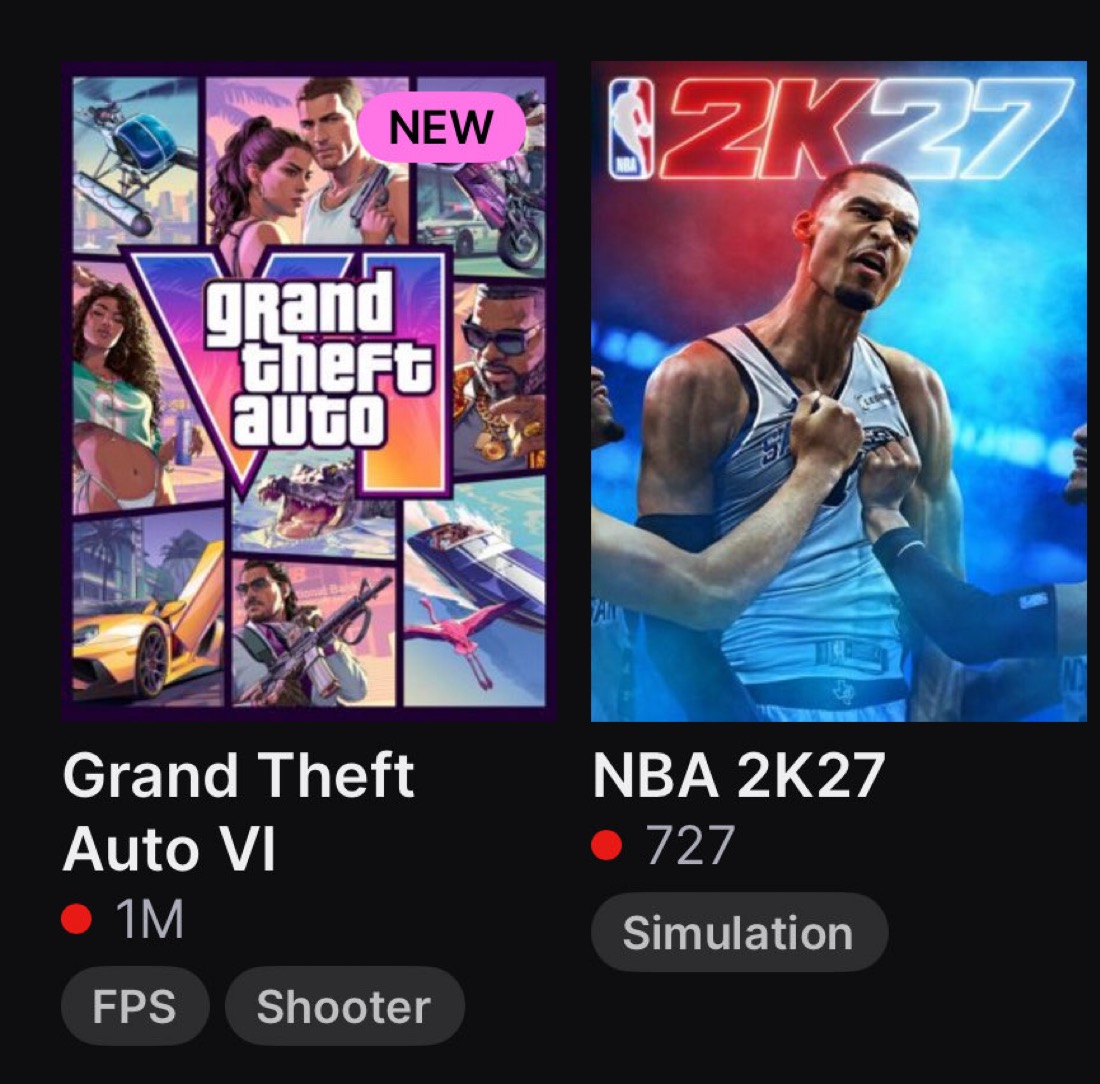
And it's not just sales. It's attention. At launch, GTA VI broke Twitch's all-time record for a single game, peaking at about 3.3 million live viewers. When I checked Twitch on November 19, GTA VI had a million people watching live. NBA 2K27 had 727. In the middle of NBA season.
But that level of brand equity also changes how your product gets judged.
GTA VI wasn't released into a neutral market. It showed up carrying decades of goodwill, hype, nostalgia and an almost unheard-of expectation of greatness. Before anyone could judge the finished product, it was already being treated as a historic event.
Want proof of how much leverage that buys you? Rockstar launched the biggest game of the decade with no PC version and every console locked at 30 frames per second. Even the PS5 Pro. Basically: "Hundreds of millions of you are going to play this at 30 fps until we say otherwise. Have fun."
What other studio could pull that off? Anyone else would get torn apart. And people did complain. They just bought it anyway. That's what brand equity really does. It doesn't stop people from complaining. It keeps them buying while they complain.
That doesn't take anything away from the quality of the game. Rockstar earned its reputation through decades of exceptional work.
But legacy has gravity. And I think some of that gravity has pulled on the conversation around GTA VI.
There's a psychological difference between reviewing an excellent video game and reviewing the most anticipated entertainment release of your lifetime. The danger is letting the size of the moment overshadow the actual qualities of the product.
A game can be the biggest cultural event in gaming history without automatically being the best-designed video game in history. Those are two different accomplishments.
What Actually Makes a 10?
My personal list of perfect video games is pretty short.
Halo. Metal Gear Solid. The Legend of Zelda. Gears of War 2.
None of them are technologically perfect. Some of them look prehistoric next to GTA VI. But their mechanics, story, pacing, challenge and creative direction work together so well that I struggle to imagine any change that would meaningfully improve my experience.
Gears of War 2 doesn't need to simulate an entire state. It needs to deliver a great campaign with satisfying combat, memorable characters, emotional stakes and a sense of escalation. And it does.
Halo doesn't need photorealistic pedestrians with unique body types and deep conversations. It needs an exceptional combat sandbox. And it has one.
A perfect video game isn't necessarily the one that does the most. It's the one that most completely becomes what it set out to be.
That's why I can call GTA VI the greatest technological and presentational achievement in video game history while still believing other games are mechanically better. I'm not grading Rockstar on a curve because its ambitions were enormous. I'm judging the experience those ambitions produced.
Final Verdict: 9.5/10
Grand Theft Auto VI is the most realistic, lifelike and immersive video game I've ever played. It has the greatest presentation in the history of the medium. Its environmental design, performances, graphics and attention to detail are on another level.
It's also remarkably close to being a perfect video game.
Give me combat that's a little more demanding and pushes me to use my gear. Give me more environmental utility. Give me criminal opportunities that react more believably to the time of day. Give me a main story that breaks from its familiar structure more often.
That's it.
I'm not asking Rockstar to reinvent the game. I'm asking for the final layer of mechanical depth that would make the gameplay as incredible as the presentation.
Honestly, I feel bad critiquing the gameplay loop as much as I have. The criticism is fair and it's legitimate. But the world-building, the voice acting and the character writing are so good that saying it out loud feels like I just disrespected someone's mother to their face. While I'm playing, it barely matters. It only matters when I ask the bigger question: is this the greatest game ever made?
And maybe the greatest compliment I can give Rockstar is that after pulling off something this unprecedented, these are the relatively small things I have left to criticize.
Rockstar built the most convincing digital world I've ever experienced. Now I want the freedom to experience it as convincingly as it looks.
GTA VI is the greatest world ever built in a video game.
The greatest game ever made is still a conversation.